Over more than three decades of interaction between the Republic of Kazakhstan and the European Union, numerous developments have taken place. From today’s perspective, cooperation between Kazakhstan and the EU can generally be divided into three stages.
During the first stage (from the early 1990s to the early 2000s), the two sides were essentially getting to know each other, with the EU taking the lead. For instance, Brussels initiated the signing of the Partnership and Cooperation Agreement (PCA) with Kazakhstan in 1995, primarily aimed at protecting European investments.
Later, the EU — supported by German researchers — began shaping its own policy toward Central Asian countries. Kazakhstan and other Central Asian states gradually shifted their perception of the EU throughout the 1990s: from initial uncertainty about the purpose of cooperation to a growing appreciation of its potential.
It is important to note that Kazakhstan’s leadership, following a multi-vector foreign policy established in the mid-1990s, adopted a balanced and pragmatic approach. Depending on the international context, Kazakhstan adjusted the intensity of its engagement with key global actors.
By the late 1990s, Kazakhstan encountered certain difficulties in its dialogue with the United States. For example, the 1999 summit in Washington was largely organized through the efforts of a Kazakh entrepreneur with close connections to the Clinton family.
At the same time, relations with other geopolitical players — namely China and Russia — required reassessment by the end of the decade, despite a promising start earlier in the 1990s.
Against this backdrop, a more active and less complicated dialogue with the European Union, whose GDP was approaching that of the United States, appeared increasingly attractive to Kazakhstan’s leadership.
The second stage of cooperation began following the 2000 meeting in Brussels between President Nursultan Nazarbayev and European Commission President Romano Prodi. At that time, the EU proposed developing a comprehensive cooperation program with Kazakhstan in a broader regional context. These ideas later contributed to the EU’s first Central Asia Strategy (2002-2006), which effectively served as an action plan.
As funding was allocated to Central Asian countries, the European Parliament became more involved and began actively criticizing Kazakhstan’s domestic political processes.
In response, in 2003 Kazakhstan’s Foreign Minister Kassym-Jomart Tokayev convened a meeting of Kazakh ambassadors in Europe in Brussels, assigning each embassy responsibility for engagement with European parliamentarians.
Thanks to the efforts of Kazakh diplomats, a visit by the Vice-President of the European Parliament to Astana was organized ahead of the 2005 presidential elections, marking a high point in inter-parliamentary relations.
During the preparation of the EU’s second Central Asia Strategy (2007-2011), Kazakhstan contributed by consolidating proposals from regional countries. At a 2006 meeting in Brussels, European officials acknowledged Kazakhstan’s role in shaping this internal EU document. The new strategy, adopted in 2007, introduced country-specific priorities, which included clearly defined expectations for Kazakhstan.
Kazakhstan responded in early 2008 with the launch of the state program “Path to Europe,” which effectively addressed many of the EU’s recommendations. The program was described as a step toward real convergence of political systems, cultures, and values.
Over time, Kazakhstan’s approach gained recognition from the international expert community. For example, analysts from the Institute for Security and Development Policy in Stockholm raised the question: “Kazakhstan in Europe? Why not?”
In 2009, Kazakhstan’s Ministry of Foreign Affairs developed and presented a concept for a new agreement with the EU, based on the country’s experience of cooperation with Russia, Ukraine, and Israel. Following the OSCE Summit in 2010, active engagement with the EU declined.
The third stage (from 2010 to the present) has been characterized by a search for new forms of cooperation, which has taken longer than expected. The main achievement for Kazakhstan during this period was the negotiation and signing of the Enhanced Partnership and Cooperation Agreement in 2015 (entered into force in 2020).
In 2019, the EU adopted a new Central Asia Strategy; however, it brought limited direct benefits to Kazakhstan, as funding was primarily directed toward other regional countries.
As the EU shifted its focus toward developments in Eastern Europe, the level of substantive engagement with Kazakhstan appeared to decline, despite ongoing meetings and summits.
Kazakhstan also responded negatively to EU recommendations regarding its external partnerships.
Overall, the evolving international balance of power suggests that the role of the European Union in Kazakhstan’s foreign policy may undergo significant changes in the future, and Kazakhstan must be prepared for this shift.
Rustem Kurmanguzhin, Associate Professor, Higher School of Artsand Social Sciences, NARXOZ University
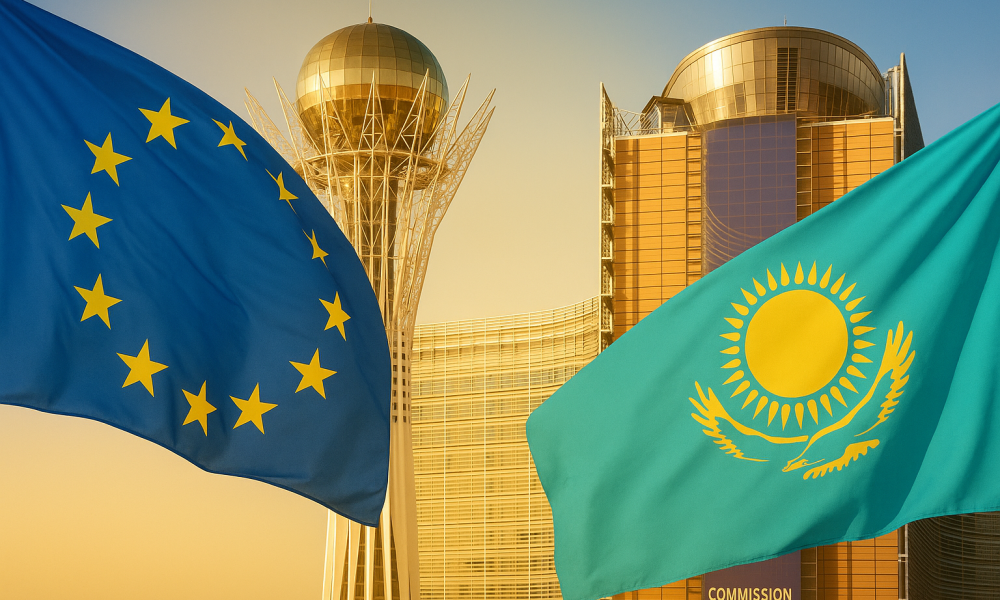
Photo: https://www.eureporter.co