Kazakhstan is entering a stage that may prove even more consequential than the adoption of its new Constitution. The focus is no longer merely on formally updating the country’s basic law, but on putting into practice a new architecture of state power. The formation of the Kurultai, the appointment of its leadership, the introduction of the institution of the Vice President, the restructuring of the government, and a possible reconfiguration of the Security Council are all elements of a single political design.
Of particular importance is how real centers of influence are being distributed within this emerging system. On the one hand, the new system preserves a strong presidential vertical and even expands the head of state’s powers, particularly in the area of appointments. On the other hand, new institutions are being introduced to ensure the more stable functioning of the state machinery and, crucially, to establish clear rules for political succession.
Yet the key question lies elsewhere: is Kazakhstan witnessing a genuine transition from a personalist model toward an institutional system, or is this instead a modernization of the presidential model while preserving the existing center of decision-making? This is where the main intrigue of the current transformation lies. The Kurultai is being granted new functions, the government is assuming new responsibilities, and additional mechanisms of public and constitutional oversight are emerging. However, the ultimate balance among these institutions will still be determined by the president.
What kind of political system is Kassym-Jomart Tokayev actually building? Why has Kazakhstan reintroduced the institution of the Vice President? What role will the new Kurultai play? And does the current restructuring signal preparations for a future transition of power? These questions were addressed by Andrey Chebotarev, a Kazakh political scientist and Director of the Center for Current Studies “Alternativa,” in an interview with CASPIA.
– At the first session of the Kurultai, Kassym-Jomart Tokayev nominated Aibek Dadabay for the position of Speaker of the new parliament. How do you assess this choice? What might Dadabay’s candidacy indicate about Tokayev’s vision for the future Kurultai?
– Given Aibek Dadabay’s professional background, he can be regarded as a member of President Kassym-Jomart Tokayev’s close circle. His emergence in the public sphere after holding a number of senior but largely behind-the-scenes positions within the state apparatus primarily indicates the continuation of the process of renewing Kazakhstan’s ruling elite. A significant renewal of the Kurultai’s parliamentary membership has been part of this process, involving representatives of all the parties represented in the new legislature.
The president set out his vision of the Kurultai’s role and activities in considerable detail in his speech opening the first session of the new body. The Kurultai and its deputies have primarily been tasked with modernizing the country’s legislation, including bringing it into line with the new Constitution of the Republic of Kazakhstan.
At the same time, the constitutional powers of this body demonstrate that it is an important instrument for legitimizing presidential decisions on appointments to the upper echelons of government. It is also one of the key links in the future transition of presidential power and in ensuring continuity of the official political course. Therefore, entrusting the leadership of the Kurultai to a person who enjoys a high degree of the president’s confidence is entirely logical.
– How significant is it that the first Speaker of the new Kurultai is a person with extensive experience in the state administration system? Can this be viewed as a signal in favor of an administrative, rather than a political-party, model for the new parliament?
– There is no straightforward answer to this question. On the one hand, the Kurultai is made up of five political parties, with “Adilet” representing the majority and the others constituting the opposition. At the same time, all of them have equal rights in terms of representation in the Kurultai Bureau, initiating draft legislation, holding hearings and government question sessions, and submitting parliamentary inquiries to the government and other state bodies.
Overall, the multiparty composition of the Kurultai is intended to demonstrate the consistency of the country’s leadership in advancing its two conceptual principles: the “Listening State” and “Different Opinions – One Nation.” All parliamentary parties also serve as instruments of interaction and communication between citizens and the state. Their role in the development of parliamentarianism should therefore not be underestimated.
On the other hand, the main agenda of the Kurultai and the legislative process depend to a considerable extent on the “Adilet” party. As a result, the overwhelming majority of leadership positions within the body have been taken by deputies representing that party.
Dadabay and his team will have to establish the highest possible standards of work within the Kurultai, including preventing excessive politicization in discussions of certain draft laws and other issues. They will also have to maintain constant interaction with the government, which has considerable influence over the legislative process. At the same time, they will need to ensure the implementation of another official concept: “A Strong President — An Influential Kurultai — An Accountable Government.”
Against this backdrop, the considerable administrative experience and institutional weight of the Kurultai Speaker, as well as that of several other “Adilet” deputies, will be in demand both for ensuring coordinated work among the committees and parliamentary factions and for managing relations with the government.
– The emergence of the position of Vice President is particularly interesting. What real function could this institution acquire within Kazakhstan’s political system? Could the Vice President become an independent political figure, or will the role primarily be associated with ensuring continuity and stability in state governance?
– The restoration of this position, which already existed in Kazakhstan in 1991–1995, is, in my view, intended, first, to strengthen the position of the president by increasing the effectiveness of his work through the delegation of some of his powers to the Vice President. Second, it is designed to ensure the stable functioning of the political and governmental system should the head of state become unable to perform his duties. Overall, the main objective is to prepare for a future transition of power and ensure continuity of the official political course.
At the same time, this time around the Vice President is not elected together with the head of state but is appointed by the president with the consent of the Kurultai. His constitutional powers are limited to interaction with the Kurultai, the government, and other state bodies. In other areas, the Vice President’s responsibilities will depend on the decision of the head of state, which will be reflected in a corresponding presidential decree.
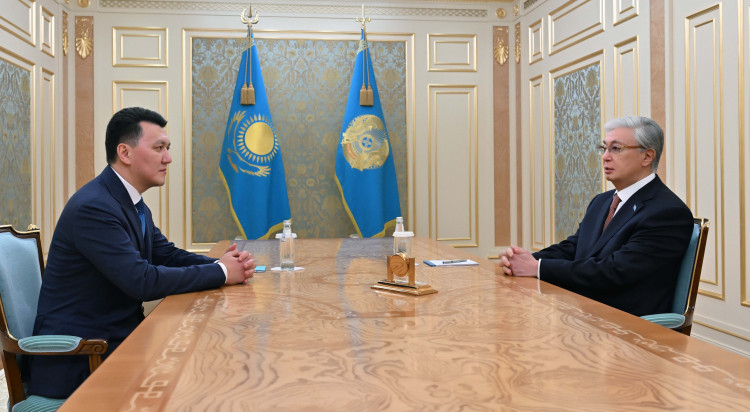
It is noteworthy that Erлан Karin, one of the head of state’s closest associates and a figure with considerable political and institutional influence, has now been appointed to this position. Therefore, it can already be said that the Vice President is becoming the country’s de facto second-ranking official.
– Following the formation of the new Kurultai and government, Tokayev has promised to deliver an annual address to the nation. Could this address become something of a programmatic document for the new political system? What issues, in your view, will be the president’s priorities?
– Apparently, yes. The main emphasis will be placed on economic and social policy. The president has already announced a number of measures, including the use of National Fund resources to finance strategically important projects. These projects themselves will be outlined in his address. In particular, attention should be paid to the construction of two nuclear power plants and the development of multimodal transport corridors.
As for the political component of the address, it will most likely focus on the activities of the new official institutions – the Vice President, the Kurultai, and the Kazakhstan People’s Council – as well as their interaction with one another.
In addition, the issue of the early termination of the powers of maslikhats at all levels and the holding of elections for their new composition may also be raised. If this happens, Kazakhstan will see an almost complete renewal of its key institutions of state power.
– The government has already resigned in connection with the formation of the new system of government. How significant a reshuffle of the cabinet do you expect? Are we talking primarily about a technical reset, or could new political and economic figures emerge?
– Given the critical issues in the economic and social spheres highlighted by many experts and media outlets, at a minimum we may see changes among the deputy prime ministers responsible for key areas, as well as among sectoral ministers.
At the same time, Olzhas Bektenov is remaining as prime minister, which allows for the maximum possible continuity in the government’s work. This is particularly important from the perspective of implementing Kassym-Jomart Tokayev’s 2022 election program.
– How will the balance among the president, the Kurultai, and the government change once all these procedures have been completed? Who will gain more real influence under the new architecture of power, and who, on the contrary, may lose it?
– The adoption of the new Constitution has strengthened the president’s position within the political and governmental system, particularly in matters concerning appointments. He has been and remains the center of decision-making and the arbiter in relations among the other official institutions.
As for the latter, the constitutional limitation on the Kurultai and its deputies’ independence in the legislative sphere remains in place, requiring government approval of draft laws initiated by them. To address the imbalance in relations between the legislature and the government, the practice of annual government reporting to the parliamentary faction of the “Adilet” party will most likely continue. Previously, such reporting was conducted before the “Amanat” faction in the Mazhilis of Parliament. At the same time, the government will be tasked with implementing the key measures outlined in the election program of this party.
The creation and functioning of the Kazakhstan People’s Council, which has the status of the highest constitutional advisory body, will significantly alter the institutional and intra-elite balance. The Council also has the right of legislative initiative and the authority to exercise public oversight over various state and quasi-state structures. However, much will depend on the identity of its future chairperson and the quality of its membership.
Another important development is the change in the structure – and apparently also the powers – of the Security Council of the Republic of Kazakhstan announced by the head of state. In particular, the position of Deputy Chairman of the Security Council is being introduced.
It is not yet clear whether the existing position of Secretary of the Security Council will be retained or whether the secretary will at least cease to be the second most influential figure within the body. In any case, given that the Security Council is chaired by the head of state himself, its deputy chairman will become an important figure both politically and institutionally.
– If we look at what is happening not from the perspective of formal procedures but in terms of the actual distribution of political influence, what is really changing in Kazakhstan today? Is a new system of checks and balances emerging, or is this primarily a modernization of the existing presidential model?
– In my view, the adoption of the new Constitution of the Republic of Kazakhstan and the establishment of the institutions provided for by it are driven by the logic of transitioning from a personalist model of governance toward an institutional one.
This is also connected with the leadership’s desire to move as far as possible away from the political legacy of former President Nursultan Nazarbayev, which is particularly important on the eve of the 35th anniversary of Kazakhstan’s independence. A sufficiently clear mechanism for ensuring the continuity of presidential power is also being established, within which the Vice President and the Kurultai will play a key role.
At the same time, the country’s strong presidential institution is being preserved. Overall, however, it would be more accurate to speak not so much of a modernization of the presidency itself as of a modernization of Kazakhstan’s entire political and governmental system, aimed at strengthening its resilience and ensuring its stable functioning.
«CASPIA Lab», 2.09.2026
Tamilla Mamedova
Photo: https://www.akorda.kz